
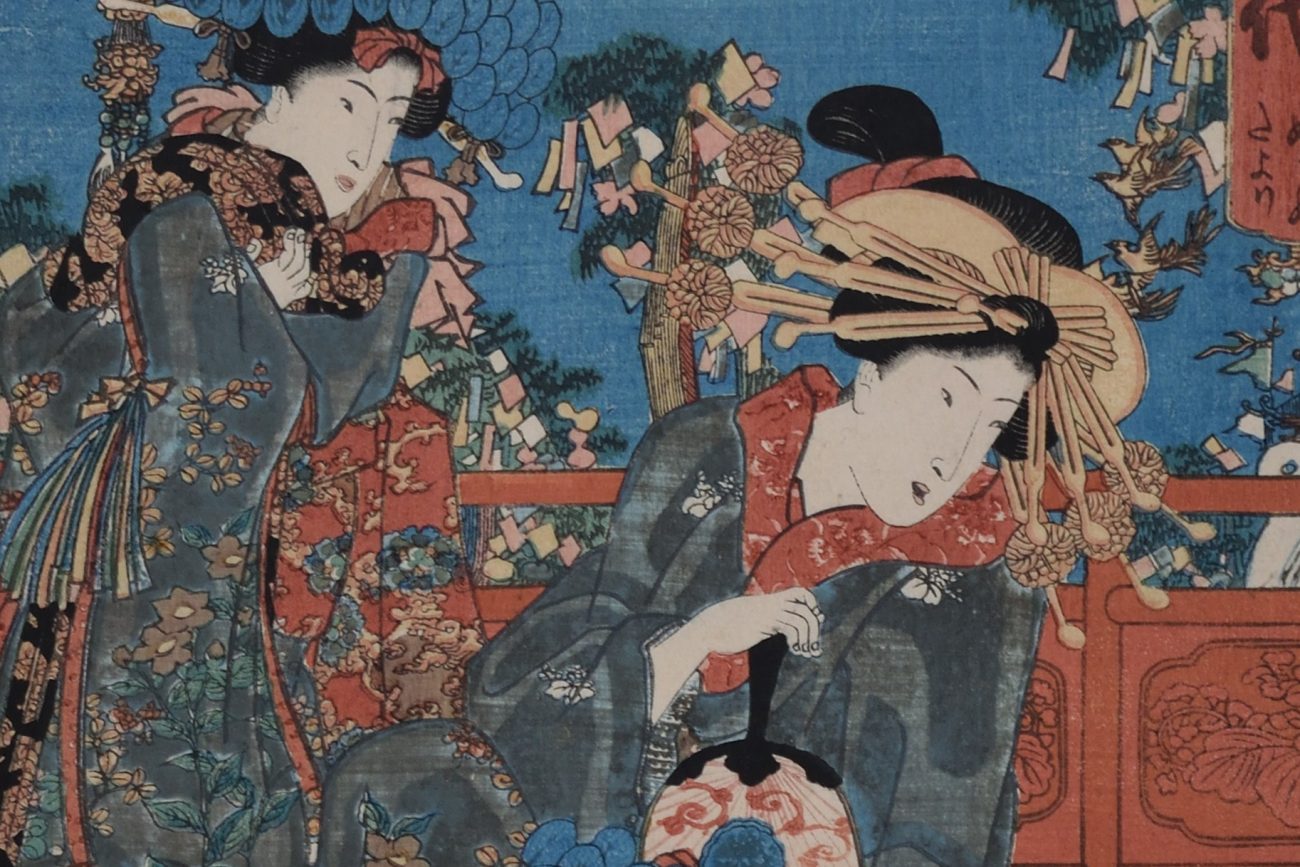
One of my favourite types of artwork to conserve are ukiyo‑e prints, also known as Japanese woodblock prints. This genre was most prevalent in Japan from the 17th to 19th centuries, although the mokuhanga (woodblock printing) technique is still practised today by artists worldwide. The term ukiyo‑e (浮世絵), meaning “floating world,” refers to the indulgent pursuits of Japanese society during a period of economic prosperity. Common subjects include kabuki theatre, sumo wrestling, flora and fauna, travel scenes, and Japanese myths and history.

Figure 1: Detail from the triptych Three Courtesans and Attendants on a Balcony by Utagawa Kunisada (1825–1842), showing a geisha and her attendants interacting with a cat. Image courtesy of York Museums Trust
I’ve recently had the pleasure of conserving 19 woodblock prints which will be part of York Art Gallery’s upcoming exhibition Making Waves: The Art of Japanese Woodblock. The works span a wide range of genres, periods, and artistic practices, making it a pleasure to work closely with them.

Figure 2: Conservation treatment included stabilisation, retouching losses in the printing media, and cutting new museum‑grade mounts.
The condition of the prints varied considerably. Some, such as Crows in Flight by Zeshin Shibata (1807–1891), were in near‑perfect condition, likely due to long‑term storage in stable environmental conditions with minimal light exposure.

Figure 3: The print was removed from its non‑archival mount, fitted with new Japanese paper hinges, and re‑mounted in a 100% cotton museum‑grade window mount.
Other prints, such as an untitled work by Utagawa Toyokuni (1769–1825), were far more fragile. While Japanese papers are known for their strength due to long fibres, they remain vulnerable to water damage, mould, pests, and past handling. In this case, moisture damage had weakened the paper, causing losses and small tears. The colours were also noticeably faded, indicating past light exposure.
Although immersion washing is commonly used to reduce staining in paper conservation, this method is rarely suitable for woodblock prints because some of the colourants can be extremely sensitive to water. Instead, a minimal approach was taken, leaving many signs of age intact. An exceptionally lightweight Japanese repair tissue and wheat starch adhesive were used to stabilise weakened areas.

Figure 4: Areas of soft, fragile paper required stabilisation to prevent further tearing. Image courtesy of York Museums Trust
Pest damage is another common issue in Japanese prints, particularly due to Japan’s hot and humid climate. In The actor Kataoka Kado as Miyagi Asojiro by Hasegawa Sadenobu (1809–1879), insect holes were clearly visible. These were infilled from the reverse using Japanese paper and wheat starch adhesive, then carefully retouched on the front with lightfast watercolours to reduce their visual impact.


Figure 5: Before and after repair and retouching of insect damage
Another print, The actor Ichikawa Sanyen in character by Kunisada, Utagawa Toyokuni III (1825–1861), had an accretion adhered to the paper surface, possibly from dirt or an insect. This was removed under magnification using a scalpel. The paper beneath had been protected from ageing, creating a colour contrast that was gently toned to restore a more even appearance.


Figure 6: The accretion was removed and the exposed area toned to blend with the surrounding paper.
Display considerations also played a role in treatment decisions. Two visually similar prints by the artist Yeishi had previously been displayed together, but curators determined they were unrelated works and requested that they be mounted separately.


Figure 7: Although visually similar, these prints are unrelated in subject matter. Image courtesy of York Museums Trust
Conversely, two different editions by an unknown artist printed from the same woodblock were intentionally displayed together, allowing viewers to compare variations in ink application and resulting atmosphere.


Figure 8: It is interesting to compare these prints, printed from the same woodblock. Image courtesy of York Museums Trust

Fig 9: A triptych, woodblock print from the later 19th century depicting female warriors,
Image courtesy of York Museums Trust
If you have the opportunity, I highly recommend viewing these prints in person at York Art Gallery, between 27 February and 30 August, 2026.
My thanks go to York Museums Trust and the Friends of York Art Gallery for the opportunity to conserve and preserve these remarkable works.
As well as Japanese woodblock prints, Artworks Conservation specialise in the conservation and restoration of a wide range of eastern art including East Asian art from Japan, China, Korea and Tibet, such as hanging scrolls, folding screens and thangkas, as well as Islamic, Mughal and Indian paintings and manuscripts
